
When Ministry Meets Machinery: Faithfulness in the Age of Impact

Updated: Apr 16
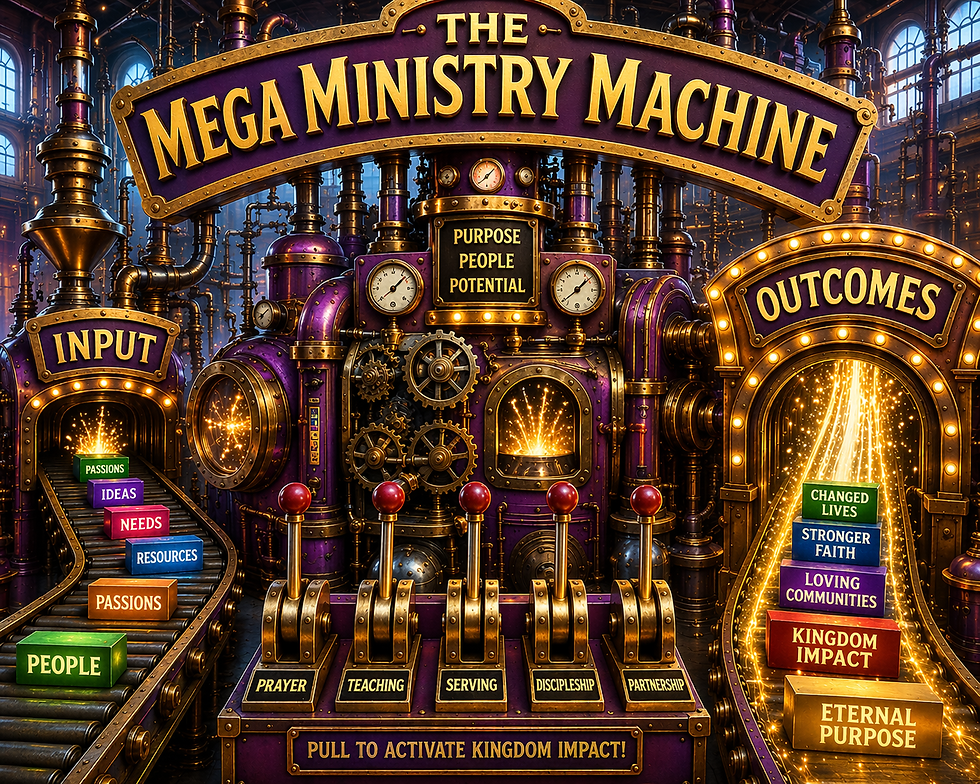
I believe something may be going wrong somewhere in and around Christian ministry.
It is happening with the best of intentions. In the name of accountability and effectiveness, Christian charities are accepting a vision of ministry shaped not by Scripture or theology, but by secular systems of measurement and control. The language of “impact,” “outcomes,” and “performance” sounds responsible (even righteous) but beneath it lies a picture of the world that Christians should find unsettling. We are in danger of capitulating, largely without protest, to a machine‑shaped understanding of ministry itself.
That may sound overstated. After all, what could be wrong with wanting to demonstrate that our work is making a difference? Surely Christians should welcome accountability, clarity, and learning. And indeed, much of what is happening in response to new regulatory expectations is conscientious, thoughtful, and well‑intentioned.
My concern is not that Christian organisations are trying to steward resources wisely. This is to be celebrated! Rather, it is that in doing so, we may be absorbing a way of imagining reality that reshapes how we understand faithfulness, fruitfulness, and the work of God.
What difference are we making? And how do we prove it?
Those questions are becoming unavoidable for Christian charities and ministries, particularly in light of the Charities SORP 2026 and its expectation that charities should “clearly evidence the difference they make in the world.” Impact, outcomes, and measurement have moved to the centre of organisational life.
It is right and good for Christian organisations to engage seriously, to clarify their aims, strengthen their reporting, and steward their resources well, but I am uneasy. Data and analysis are not inherently wrong, but something deeper seems to be going largely unexamined.
The updated regulation reveals underlying assumptions about what a charity is, how change happens, and what counts as real in the first place. Over time, these assumptions reshape our imagination for ministry itself. And imagination, once reshaped, never leaves practice untouched.
The assumption beneath “impact”
At the heart of the new regulatory emphasis lies a simple idea: charities should be able to demonstrate the difference they make in the world. On the surface, this sounds morally obvious. Surely Christian ministries should care about whether their work is helpful, effective, and worthwhile.
But embedded within is a deeper assumption about the nature of ministry itself.
The dominant picture is of a charity as a system designed to produce outcomes. If inputs are defined clearly, processes mapped carefully, and outputs measured rigorously, then outcomes can be evidenced and impact demonstrated. Change becomes something we can design, manage, and validate.
This way of thinking has become so normal that it passes without comment. Yet it rests on a particular metaphor so familiar that we barely notice: the charity as a machine.
Machines have inputs and outputs. They can be optimised, scaled, refined, and improved. Progress means expansion. Success means performance. Evidence is what can be quantified, compared, and reported.
To say this is not yet to say it is wrong. The problem arises when metaphors come to govern our thinking without being named. When that happens, they stop functioning as metaphors and start functioning as reality.
Why metaphor is never “just language”
This is where philosophy of language becomes unexpectedly relevant. In Metaphors We Live By, George Lakoff and Mark Johnson argued that metaphor does not merely function descriptively, but shapes our understanding of the world itself. We do not first grasp reality and choose metaphors to describe it; rather, we perceive and interpret the world through metaphors already at work in our language and imagination.
Once a metaphor becomes dominant, it trains our attention. It teaches us what counts as real, what matters most, which questions are sensible, which outcomes worth pursuing.
When Christian ministry is framed through machine imagery, measurement ceases to be a neutral reporting tool. It becomes formative as what we choose to measure begins to shape what we value. We reward what we measure, and over time the visible and scalable take precedence over the hidden and relational.
Growth therefore shifts from spiritual depth towards numerical expansion. Fruitfulness begins to resemble productivity. And people risk becoming units within a system rather than neighbours, fellow pilgrims, or brothers and sisters in Christ.
None of this requires bad intentions. It happens because our imagination (individual and collective) exerts power beneath the level of conscious choice.
When measurement replaces reality
At this point my concern deepens as metrics come to replace the reality they’re meant to describe.
The philosopher Jean Jacques Baudrillard used the language of “simulation” to describe situations in which representations no longer point beyond themselves to something real, but begin to stand in for that reality. Over time, people stop acting in response to the thing itself and start acting in response to the representation. The copy takes on its own life.
This risk is particularly acute in Christian ministry, because the most important realities we care about are not directly measurable. Faithfulness, repentance, love, humility, perseverance, and trust cannot be captured as data, but their proxies can.
So, attendance can stand in for commitment, participation for discipleship, and program completion for formation.
Initially, we know these are approximations. We speak cautiously. But over time something shifts. The thing we measure becomes the thing we aim at and the proxy becomes the goal.
Then the systems become more sophisticated as the data becomes cleaner. Our reports may become more confident, even as our grasp of reality becomes more uncertain. It is entirely possible to become highly skilled at managing a simulation of faithfulness without cultivating faithfulness itself.
Consider something as simple as conversion: We begin by asking how many students come to faith, then define what we can count: a raised hand, a prayer, follow-up attendance. Soon, we design events that produce clearer “responses,” train leaders to recognise them, and report them confidently. The number rises but a question lingers: are we witnessing new birth, or have we learned how to generate countable moments that stand in for it?
History is littered with examples of individuals and ministries who have done just this.
Jesus, impact, and the Parable of the Sower
At this point, some Christians may object. Doesn’t Jesus himself speak in terms of measurable fruit? In the parable of the sower, after all, we hear of harvests yielding thirty, sixty, and a hundredfold. Isn’t that impact? Isn’t that measurement?
The objection is understandable, but I think it misunderstands what Jesus is doing in the parable.
The parable is not simply about the outcomes of preaching God’s word. It is about how those outcomes might be seen. Many have pointed out that the sower scatters seed with extraordinary recklessness. By any efficiency standard, it looks wasteful as seed falls on the path, or among rocks and thorns.
Then, some growth looks highly promising. At first. Seed on rocky ground springs up quickly. Seed among thorns survives for a time. Early indicators would suggest success! If we were tracking engagement, enthusiasm, or immediate response, we would be encouraged.
Yet Jesus’ parable reveals that these signs can be misleading. What looks like impact turns out to be shallow and apparent fruit proves temporary. The real difference is not visible at sowing, or even at early growth.
Here’s the point: the real difference—the lasting fruit or ‘impact’—is visible only at harvest-time.
So, yes, the parable speaks of measurable yield. But the crucial question is this: who does the measuring? It’s not the sower. It’s the Harvester. And in the context of the parable (and Jesus’ parables more generally) there is only One Harvester!
Which is why this parable builds epistemic humility into the very fabric of discipleship. It warns against premature certainty and resists linear assumptions about cause and effect. Above all, it insists that the final evaluation belongs to God himself who is and forever will be the holy, righteous, and gracious judge of all.
Christian theology has long had language for this kind of humility. We have always insisted that our knowledge of the world, and especially of God’s work in it, is partial, provisional, and creaturely. God’s knowledge alone is complete; ours is derivative and limited. The older theological distinction between God’s archetypal knowledge and our ectypal knowledge makes this point: we never possess reality as God does, but only as it is accommodated or revealed to us. That is not a failure of faith; it is the condition of being human. Any system that forgets this and promises confident, comprehensive accounts of spiritual fruitfulness is not merely optimistic, but theologically (and anthropologically) naive.
The point is: Fruitfulness is real, but it is not finally ours to quantify, manage, or claim.
Story, testimony, and knowing God’s work
This is why I find the suspicion of narrative and testimony in some quarters troubling. Stories are how human beings recognise personal, relational, and spiritual realities. They are not weak evidence!
Consider that Scripture itself comes to us as narrative, not dataset. Why? Because God works through persons, over time, in relationship. Testimony is not “mere anecdote.” It is how the people of God have always borne witness to repentance, calling, healing, faithfulness, and grace.
So, whilst we needn’t reject metrics and data and impact measures, we surely must recognise their limits . Impact data can inform reflection and support learning, but it must remain servant, not master. It is a witness, not an arbiter of truth.
It is striking that other human‑facing disciplines have learned this lesson. In my wife’s field of counselling and psychotherapy, there has been growing caution about treating “evidence‑based practice” as the sole arbiter of truth. The pushback has recognised that practice itself generates a different kind of knowledge. “Practice‑based evidence” acknowledges that human change is contextual, relational, and resistant to standardisation. Evidence still matters, but it is interpreted, held, and judged in the complexity of lived reality.
Christian ministry should find this language immediately familiar. After all, it deals with persons before God, not merely behaviours. To imagine that the truth of such work can be settled purely by externally validated indicators is not rigour, but reduction. It forgets that our knowing is always situated, and that the deepest truths about fruitfulness will always exceed what systems can see.
A call for theological alertness
We need caution. Left unexamined, the logic of impact will not simply sit alongside Christian ministry; it will reshape it. We may become adept at demonstrating outcomes while forgetting how to discern fruit, fluent in the language of success while forgetting the grammar of the Kingdom. The danger is that even as we satisfy regulation we may be allowing a machine‑shaped imagination to teach us what counts as real.
The Kingdom of God does not grow by optimisation, and does not submit to metrics. Christian ministry has always lived with uncertainty, patience, and trust by sowing generously and waiting for fruit we cannot produce or predict as “God gives the growth.”
The true harvest belongs to God, and he alone knows how best to measure it.


Comments