
Ishmael or Isaac: What Our Measuring Is Doing to Us

How often are we building kingdom caricatures, rather than receiving the real thing?

A danger of doing some public processing is that you get asked good questions. (Or semi-public processing, really. I’m under no illusions on how far these posts travel—the metrics tell me that much!).
Since resurrecting this page a few weeks ago, I’ve done some semi-public processing of metrics and impact measurement. I don’t really know what impact that might be having, but it has been helpful to think it over. And as others have responded, my questions have sharpened. So (with apologies) here I am again.
This time, here’s my question: As Christians in ministry, and as Christian ministries (whether church or parachurch), whether we value metrics, data, measurement and impact or not…
What does our measuring do to us?
Measurement: A Gift We Should Not Dismiss
I suspect many organisations don’t start with that question. Rather, measurement feels obvious. So, if something matters, we track it. If we care about people, growth, impact—we want to know what is happening.
That’s right, of course. Currently at UCCF we’re taking bookings for our annual student-leaders conference (Forum) in September. We want to know how many students are coming because we want to care for each of them well. We also want Forum to equip as many Christian Union leaders as possible, as fruitfully as possible.
Data and metrics can help us pay attention. They can show patterns we might otherwise miss, reveal problems early, and might help us test whether our assumptions match reality. They help us steward people, time, and money with some clarity. Used well, measurement should be a tool to help us tend the fruits of faithful ministry.
When Tools Become Teachers
But here’s the issue we have to keep always in mind: measurement is never ‘just’ a tool. As Ivan Illich once warned, tools do not merely serve our purposes, but come to shape those who use them.
We don’t just use metrics, we return to them. That’s the point! A one off number tells us very little—and can often be more confusing than anything else. So measure and measure again. Regularly and repeatedly. Then we ask the numbers we produce to have an effect: we want them to influence what we notice, what we celebrate, and what we pursue.
We know from the rest of life that what is regularly repeated creates rhythms which shape us. But the question I don’t hear us asking very often is, what do our repetitive measurement practices do to our instincts about what matters?
This is where we might have problems.
The Illusion of Control and the Logic of “Growth”
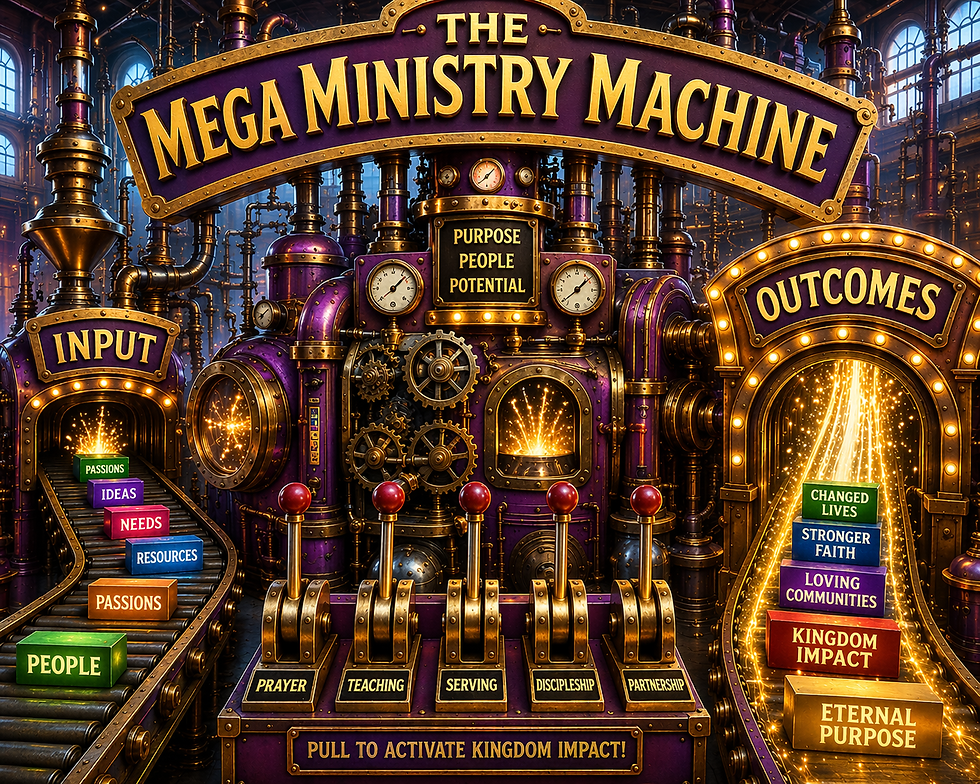
Measurement practices, processes driven by metrics and impact, inputs and outputs—none of these are neutral. They are born of an ideology and epistemology aiming for mastery.
In other words, the more we measure, the more we can begin to believe we control.
If something can be tracked, it can be improved. If it can be improved, it can be managed. If it can be managed, outcomes are within reach. If outcomes are within reach we can celebrate progress. We can call it ‘growth’.
The Kingdom that Refuses to Be Managed
That shift matters in Christian ministry because the reality we’re dealing with doesn’t actually behave like that.
Some assume that Jesus’ parables happened to be agrarian because that’s the world he lived in. As though his imagery is merely an accident of history and timing.
But I don’t think for one moment that if Jesus had ‘happened’ to live during the industrial revolution, he would have reached for factory-floor metaphors as though they would be perfectly interchangeable. God’s sovereign timing is more deliberate than that. When the set time had fully come, God sent his Son… (Gal 4:4).
God’s creation purposes are also more deliberate than that. When Jesus describes the kingdom like seed scattered on the ground. or growing whilst no one is watching, it’s no accident. The seed exists and behaves as it does in part so that Jesus could make this point! As it grows in ways the farmer cannot explain (“though he does not know how”) we are confronted with the mystery of God’s kingdom. It is real, visible, but not controllable.
Paul puts it similarly: “I planted the seed, Apollos watered it, but God has been making it grow” (1 Cor 3:6). There is work—even a sowing and watering strategy to work on—but the decisive action belongs to God.
What Happens When Waiting Becomes Unbearable
I think the story of Abraham speaks into this.
God’s promise to Abraham—a son, a future, a people, blessing to all nations—doesn’t move at the pace Abraham wants. There are long stretches where nothing visible happens. That delay brings Abraham to a decision.
When Abraham and Sarah plan to use Hagar, bringing about Ishmael’s birth, they reach for action when waiting feels unbearable.
Ishmael is a real flesh and blood son of Abraham, and image bearer of God himself. But he is not the seed of the promise. Ishmael’s birth is what happens when the pressure to see progress overtakes the call to trust.
That pattern isn't hard to spot. When the outcomes we long for feel distant or slow, we look for ways to bring them closer. If we aren't paying attention, metrics can become part of that move, and can also fuel it—not because measuring is wrong, but because the act itself offers visibility, immediacy, and a sense of action.
From Proxy to Substitute
So, if we measure without asking what measuring is doing to us, we risk building a caricature of the kingdom rather than receiving the real thing.
A metric begins as a proxy pointing to something richer. Attendance stands for belonging, engagement stands for depth, decisions stand for discipleship, etc. But the proxy itself is easier to act on, easier to report, easier to improve, and easier to control. Alasdair MacIntyre famously observed in After Virtue, that institutions tend to privilege measurable external goods over the internal goods that give their practices their meaning.
My point is that some of our metric measurement is not merely evidence of this shift; it is often one of the mechanisms by which it takes place. As we optimise for measures, we turn faithfulness leading to fruitfulness into effectiveness leading to impact.
Those aren’t neutral substitutions.
Whereas faithfulness keeps the focus on obedience and fruitfulness leaves room for God-given growth, effectiveness and impact often point to outcomes and say: this is what we achieved.
It seems to me that the logic of the kingdom resists that: “I planted, Apollos watered, but God gave the growth.” The roles are real, but they are limited. The outcome is real, but it is given.
Measurement, if held carelessly—in ways which are all too common in our ministry ecosystem—can and will blur that distinction by making growth feel traceable back to us in ways that leave less room for dependence, less requirement for prayer, and less clarity about who receives the glory.
Receiving Data Without Claiming Credit
That might be the risk, but in case you think I’m saying we shouldn’t measure anything ever, let me say that it isn’t the only possibility. I’m not arguing for an absence of measurement and data. I’m asking us to do the measuring far more carefully.
Held well, and received well, metrics can serve mission.
The point is, we need to relate to metrics, measurement, and impact differently to our instincts in a machine-driven (and fallen) world.
Perhaps there are two ways to do that:
The first is to reflect on the source of data and the insight it brings. One long-standing insistence at the heart of Christian theology is that all human knowledge is derivative. There is a sense in which any metrics we have collected, we have received.
So, do we have measurement practices which give room for organisational liturgies of receipt? Do we have ways to acknowledge the limits of our understanding, and thank God for what we can measure, know, and understand?
Asking Better Questions
The second difference needs to be found in the questions we ask.
We often ask: “What does this data tell us?” It sounds reasonable, but leans towards control. It assumes the data yields clear conclusions, and that with enough analysis we can extract a definitive account of reality.
What happens if we reframe the question: “What might this data mean?”
That’s a different posture with room for context, limitation, and things the data cannot capture. It’s a small shift in language, but reflects the epistemic humility we can’t do without.
We are not omniscient—we do not see the whole. Nor can we finally explain how growth happens. God only knows!
Signposts, Not Substitutes
If we’re prepared to work hard at organisational practices like these, it might transform our relationship to impact measurement and all the rest. Metrics should be signposts, not substitutes, prompting attention rather than defining reality.
Practically, that might play out in a few ways. Numbers might stay in open conversation rather than taking control. Metrics will be paired with stories (testimonies not anecdotes?!), so that what can be counted doesn’t crowd out what cannot be counted. Meanwhile, the horizons we look to can include the time to allow for the slow work of God’s kingdom growth, whilst our regular rhythms retain space to ask what is missing, what feels unseen, and what doesn’t fit our accounts of ‘what God is doing.’
The story of Abraham and Ishmael was not a failure of effort, but a failure of trust. Isaac didn’t arrive through better strategy, but through patient dependence on a promise kept by God alone. Measurement and metrics will always sit somewhere between those two.
So, the question is not whether we should act, plan, or count. We self-evidently can and must!
The question is whether our acting, planning, and counting trains us to wait, or forms us towards replacing waiting with control.


Comments